
 562 628 1675
ImageCat presented at the 13th U.S. National Conference on Earthquake Engineering (13NCEE)
04 Aug 2026
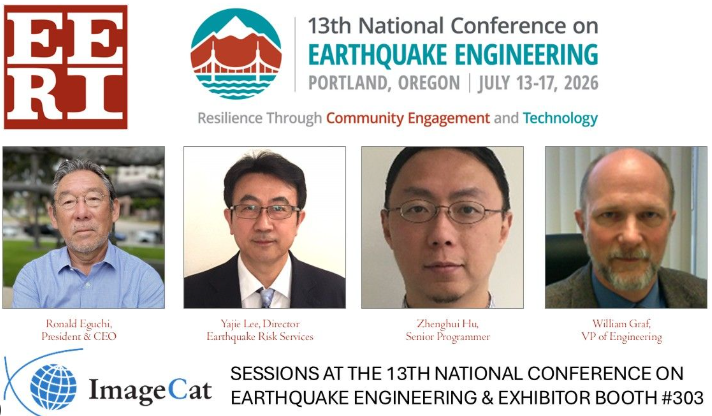
The 13th U.S. National Conference on Earthquake Engineering (13NCEE) was held in Portland, Oregon from July 13th to 18th, 2026. The Earthquake Engineering Research Institute (EERI) organized the event, which is held every four years. The gathering brought the international earthquake community together to present and discuss new ideas and advances in the field of earthquake and tsunami science, including current practices, mitigation, and public policy. ImageCat was represented by Ron Eguchi, ZhengHui Hu, Yajie Lee, and William Graf.
On July 16th, Ron co-moderated the special session From Hazard to Risk: Tsunami Impacts by Integrating Earth Observation, Exposure, and Real-Time Forecasting in a Changing Climate. In the session, ZhengHui Hu presented TsunamiCat-an online tsunami risk visualization platform. TsunamiCat is a comprehensive tsunami risk and loss assessment platform for the U.S. West Coast, leveraging cutting-edge earthquake and tsunami models, advanced cyberinfrastructure, and Earth Observation (EO) data to characterize building inventories and exposure.
Ron also co-moderated the special session Lifeline Infrastructure Resilience: A System-of-Systems Challenge. The presentations in this session highlighted the Lifelines Infrastructure Hub, a national platform created by the National Institute of Building Sciences (NIBS) to bring stakeholders together for open communication about and solutions to gaps in lifeline resilience.
Also on the 16th, Yajie Lee presented Enhancing Decision Stability in Seismic Hazard and Risk Updates by Explicitly Accounting for Epistemic Uncertainty in the session, Insurance applications and Catastrophe Risk Modeling. Decision-makers are constantly navigating swings in hazard and risk assessments driven by evolving models, while stability in decisions and policies remains highly desirable in practice. In this talk, Yajie presented an innovative approach to addressing this dilemma: leveraging the best available science from updated models while enhancing decision stability by acknowledging inherent scientific uncertainties.
On the 17th, William Graf presented Collapse Risk Screening in Seismic Risk Assessments in the session, Seismic Analysis and Design Methods II. ImageCat team members Yajie Lee and Michael Eguchi contributed to the presentation which compared the tools available to estimate collapse probability for a defined ground motion scenario as a part of seismic risk assessments performed per ASTM E2026, and suggests use of CODA-Collapse. It further described how collapse and damage estimates are linked, and how to estimate the probability of collapse within an exposure period defined by the user (e.g., owner or lender), providing a clear result for the ASTM requirement on building stability.


 twitter